
Reporting from Day 1 of Online Connectivism Conference (OCC) 2007
(February 2nd – 9th)
“This meeting is of historic importance!†one member of the opening live session of George Siemens stated when the lecture with permanent active chat discussion in Elluminate at last Friday was finished. As two of the nearly 200 participants (my counter showed 198 exactly!) in this great event at the OCC 2007 we were really very impressed by the international attendance (from Canada, Netherlands, Australia, Great Britain,…) and by the amazing knowledge creation which was taking place in about 80 minutes. And although it was not possible to follow both interesting knowledge sources (ppt-lecture + chat) generated meaningful information at the same time in every detail it was an exciting experience for us as we are students in a small town called Ilmenau in Thuringia / Germany who were able to talk and listen to an expert round never would be possible in an actual course at university. In addition to that Thomas and I had a chat with each other during the session to think about the upcoming ideas and its usefulness for our PLE-project. I really felt “connectivised†*I hope this is verbalized correctly.* 🙂
Also the session itself was recorded and will be provided by George. The ppt-file can be found here already and lively discussions are taking place at the appropriate Moodle Server. Thanks a lot for this great engagement!
8 days before George Siemens posted the preconference presentation “Situating Connectivism: Relation of existing theories of learning and knowing“ which gives a widespread overview about learning theories. In this presentation he also defines some interesting aspects which could be inspiring for further discussion in our community that a learning theory should provide 3 functions to be a learning theory:
- It should explain and predict.
Explain what is happening today and what is going on.Predict if persons are engaged in a particular learning activity there occurs a particular outcome with similar results by testing with other persons. - It needs to advance a discipline.
That means providing a way of understanding learning as it is occurring in a particular space. - It should prepare us for future needs.
Especially in a society of information growth in which technology continues to make our landscape more and more complex and in which global conversations are enabled like homely discussions a perspective of learning is required.
Furthermore he suggests not to put learning theories in opposition to each other but instead explore where theorists agree and where the principals of theorists begin to influence a theory and practice of learning in a technology enabled environment!
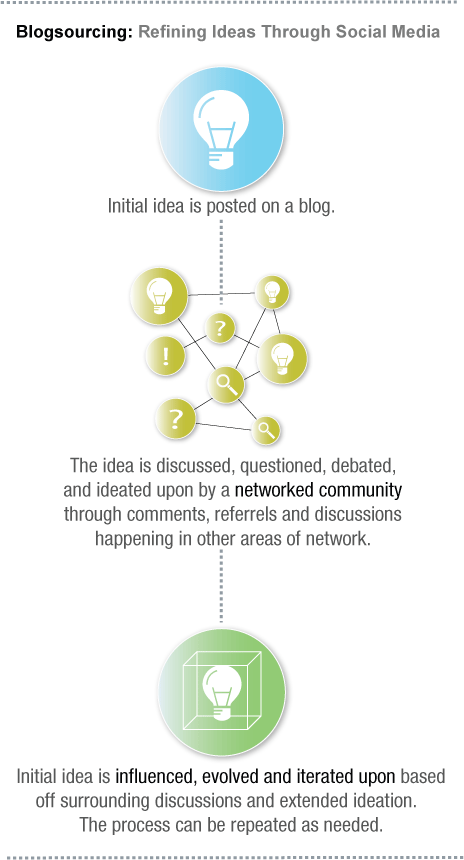 In his online lecture on Friday “Connectivism: Learning conceptualized through the lens of today’s world.“ he brought up the following selected aspects:
- “We can’t see the way out yet because we are thinking within the existing structure. That’s why we are still having discussions about constructivism vs connectivism (or some such model). Connectivism is entirely different – not fixated on the learning model of ‘in head with aid of socialization’. Knowledge – and the affiliated concepts of learning and understanding – is a function of ‘the network’ â€.
- “A connection is the awareness with potential for relationship. Each node is a portal to a new network.â€
- “Connectivism means networked learning […] our ability to learn and stay current is directly related to the strength and diversity of our personal learning network. […]â€
Moreover as an example he picked up a nice visualization of blog activities (as you can see in the picture) which reminded me directly on the development processes in our blog.
Image Source: http://darmano.typepad.com/
Last but not least he defined skills that learners need which can be found also in his book “Knowing Knowledgeâ€(p.113):
- pattern recognition
- network formation and evaluation
(how to create a network and how to evaluate – it means to get an overview to develop solutions) - critical / creative thinking
- acceptance of uncertainty / ambiguity
- contextualizing
(learn to “think in hyperlinksâ€)
Our ideas during the session were that connectivism displaces the focus from having knowledge to finding knowledge. That means knowledge is added among each other. Not all members in a community know everything. And as a “connection builder†I´m able to find out whom I have to ask to solve my problems or to fill my knowledge gap. Therefore learning occurs out of the network. I do not have to know how a particular technology has been programmed but I must get to know that it exists whom I have to ask and how I can use it to reach my goals.
One can say that the OCC by now is a very enriching event for all participants and interested people. We are really looking forward to the next sessions.
With best regards
your e2.0-Blogger

Hey guys, very interesting report. When having a look at the gfx on the left side of the entry I immediately thought about a blog-entry regarding Thierry Crouzet. See more about what I mean here:
http://www.ifeb.uni-bremen.de/wordpress_staedtler/?p=60
The PPT-File link does not seem to work. Perhaps you could check the URL? Just want to repeat: Nice report. Thank you for it. Since this „Connecting“-thingy connects pretty well to my thoughts about „Social Software“ I will also add a trackback to this entry here.
Ok, trackback has to wait. I do not find trackback-url-links on your blog. seems they are deactivated or do I just not see them? I will check back later. 🙂
Hi Helge,
thank you for connecting 😉 and your link.
The URL has been checked and the mistake removed.
I´m looking forward for some nice discussion about Social Software again shortly!
Hi Helge,
thanx for the hint: we have simply forgot to integrate a trackback-url-link. Know you will find the link on the bottom of every post.
Bye, Thomas.
Pingback: Helge Städtler
Pingback: Helge Städtler » Blog Archive » BlogBlick: Connectivised Quark-Proceedings zu effizienten Social-Elephant-Weblogs - Thetawelle
Thanks so much for all you contributed to this conference! I really appreciate the google videos and would love to know you made them! I tried camtasia… got the video but not the audio! Your notes are very helpful. Thanks again!
Hi Carol,
First of all, thanx for making a overview of our recordings (http://tltknowledgelog.wordpress.com/occ-video-presentations/)!
Now to your audio-problem, while recording the elluminate-sessions I had the problem too. Reason is, that camtasia and elluminate uses the same resources: audio-card und microphone-port. In the Camtasia Recorder – audio setting –> „Audio…“ I have selected the option „Speaker Audio (what you hear)“. Ones you click on record in Camtasia Recorder, there will be displayed in elluminate the hint, that „a programm uses the audio resources“ and if you want to change this, choose „no“. It will appear several times, just push „no“. That’s it.
Hopefully, I could help you.
Thomas
Hi! I was surfing and found your blog post… nice! I love your blog. 🙂 Cheers! Sandra. R.